Asked about the relationship between fact and fiction in his work, the historical novelist typically defends his enterprise by pointing to the perquisites of poetic license and urging respect for his application of tools such as conjecture, imagination, and intuition. At best, a defense on those terms leads to a reassessment of certain isolated facts, but rarely does it pose a challenge to the very categories of fact and fiction, categories which make praise available to the historical novel only insofar as it conforms to paradigms generally belonging to traditional historical writing. I like to think Last Refuge of Scoundrels, a novel about the relationship between fact and fiction in the telling of history, offers a new answer to the question, an answer consistent with its attempt to capture the American Revolution not as written, but as lived.

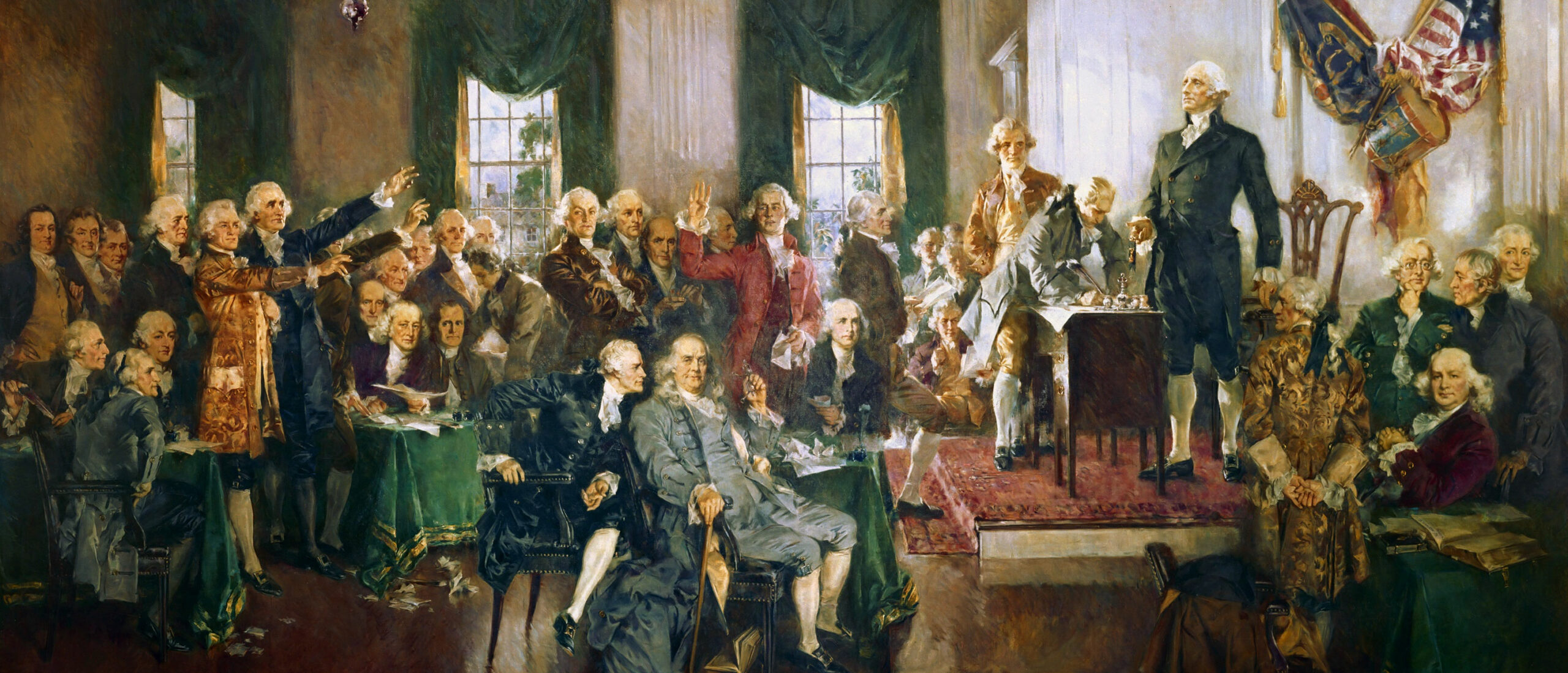
Notwithstanding valiant dissenting renditions by Howard Fast, Gore Vidal, Edward Bellamy, Kenneth Roberts (and scant few others), popular renderings of America’s founding have remained largely unchanged since Parson Weems first foisted his cherry-tree folktale upon our culture in 1806. And, like it or not, the Weems view of the Revolution still influences the American imagination: the hallowed light around Washington shines upon each of the Founding Fathers, revealing them as men of unalloyed virtue who, with selflessness, enlightenment, and an appreciation for all things fair and true, inspired an entire country to arms solely upon the strength of their great ideas.
Meanwhile, traditional military and political history, with its exclusive focus on battles, meetings, and writings of the Founding Fathers, embraces Weems-style protagonists: these histories require not human beings to people its narrative but symbols of righteousness. As a result, the common folk who actually fought the war with revolution–not independence–as their goal (the case with my protagonists John, a feminized aide-de-camp of Washington, and Deborah, a prostitute who fought disguised as a man) are either eliminated from the story altogether or branded enemies of the cause. And those who fought for independence without concern for democratic revolution don’t fare much better, rendered as mere mouthpieces for the Founding Fathers’ documented ideals. Consequently, when it comes to popular representations of the “lesser sort,” last year’s Hollywood film The Patriot is, sadly, about as good as it gets.
Certainly our narratives of the American Revolution have grown smart and plucky over the years (Jefferson in Paris, the History Channel series Founding Fathers); these days it seems Americans prefer their Founding Fathers warts and all: fresher, snappier, even naughty. John Adams’s fantasies included being crowned the next American king when the war was over. Samuel Adams was a slob and an embezzler. Ben Franklin had a girlfriend, one Madame Helvetius, who would kiss her lap dog on the lips and swab up its excretions with her chemise. While I, too, am admittedly guilty of having great fun with such details in Last Refuge of Scoundrels, one could argue that these touches–in making the Founding Fathers more identifiable, more fun–only reinforce their longstanding stranglehold on the story of the American Revolution. A seemingly patriotic hold that, in misrepresenting the Founding Fathers as front and center, marginalizes the efforts, thoughts, and ideas of common people (as detailed in sources such as diaries, letters, etc.), and, thus, creates powerful textual support for their continued marginalization across the board: from the history books we read to the political infrastructure we live.
To those who deem alternative sources (diaries, etc.) and the details they generate unreliable, I have only to say that I cannot see any reason why, for example, Samuel Adams’s accounts claiming the fervor in 1765 for the lawyer-driven, anti-Stamp Tax movement should be considered more reliable (particularly given his avowed mission to propagandize on behalf of the movement) than contemporaneous accounts of:
ordinary folks documenting protests for fair bread pricing; women protesting a system that accorded them little or no authority in their male households;
indebted farmers holding the likes of John Hancock responsible for the prohibitive cost of land, and decrying the emerging shenanigan by propertied men to fence in land once deemed common and then exact a fee for farmers to graze their cows where once they had freely roamed;
indentured servants imagining a day when they would not be expected to step in the sewage sludge that ran in rivulets along the sidewalk so that a rich man could be afforded easy passage.
While some reviewers have called Last Refuge of Scoundrels groundbreaking for exposing such facts, these “revelations” are not what is new about the book. As anyone familiar with recent American historical scholarship is aware, perspectives which incorporate these kinds of details have been found in academic writing for decades. If the book is groundbreaking it is because it avails itself of these facts to spin a story–a novel–of the American Revolution unlike anything popular culture has, to date, produced.
Facts alone seldom change how people think about their past. Stories, however, go where facts cannot, speaking directly to myths that shape culture. Those of us who want to change collective memory are compelled, in my view, to take stock of how traditional historical narratives have managed to achieve such deep entrenchment in our culture. I hazard the hypothesis that were it not for two hundred years’ worth of storytellers supporting the single-minded apotheosis of the Founding Fathers (from Weems on), our popular myth of the American Revolution as merely a parade of the Founding Fathers would not be nearly as unevictable as it is.
I feel strongly that current historical scholarship, especially social history, must find its port of entry into the popular marketplace. Some recent works, such as Alfred Young’s excellent The Shoemaker and the Tea Party (Boston, 1999), stride significantly in this direction. Yet even this pioneering work alone is not sufficient. In my view, to successfully shake the popular hold of traditional “cherry-tree” mythology, social history must tell its own stories based on its own paradigms of history. We must become historytellers. I recognize fully that the exigencies of stories that appeal to a broad public–good vs. evil, pace, structure–require above all else an overarching viewpoint, and this might seem, at first blush, incongruous with the basic methods and principles of historical inquiry. But in answer to the concern that such consensus making must involve compromise, nostalgia, or false heroics, I offer Last Refuge of Scoundrels, which I like to think achieves consensus sufficient for good storytelling while avoiding these pitfalls. The novel is the dramatization of the American Revolution told from the vantage point of many people, from all ranks of society, coming to the Revolution for a myriad of purposes. Purposes coalescing in a story. A story of the Revolution as it was lived, breathed, experienced: as the struggle amongst a people to claim its meaning, to name it for themselves and call it their own.
So what is the relationship between fact and fiction in Last Refuge of Scoundrels?
It’s the story itself. Now is the time to begin a dialogue, the particular approach of Last Refuge of Scoundrels notwithstanding, about what historytelling is and could be. For I fear that, without embracing story, the noble endeavors of social history will remain as marginalized and ghettoized as the lives of ordinary men and women whose perspectives we must continue to hail.
This article originally appeared in issue 2.1 (October, 2001).
Common-place asks screenwriter and novelist Paul Lussier about the relationship between fact and fiction in his novel about the American Revolution, Last Refuge of Scoundrels (New York, 2001).